
NUBEQA IS APPROVED FOR YOUR PATIENTS WITH mCSPC and nmCRPC ACROSS A RANGE OF DISEASE CHARACTERISTICS1-4
In mCSPC, choose NUBEQA—the only ARI FDA-approved with and without docetaxel1,5-7

See Michael’s story
Age 67 | mCSPC
Who Michael is:
- A happily married golf lover who enjoys the game with his sons
What Michael wants out of treatment:
- To delay progression, even if that means considering chemotherapy
Medical history:
- Family history of prostate cancer
- Asthma (treated with montelukast)8
PC history:
- Diagnosed with de novo mCSPC within the last 2 months1
Clinical characteristics1,2: | |
| ECOG PS | 0* |
| Gleason score | 9 (5 + 4) |
| Current PSA level | 105 ng/mL |
| Metastases | 4 bone metastases and 1 pulmonary nodule |
*Definition of ECOG PS 0: Fully active, able to carry on all pre-disease performance without restriction.9

See Andrew’s story
Age 61 | mCSPC
Who Andrew is:
- A grandfather who enjoys quality time with his family
What Andrew wants out of treatment:
- A treatment he can stay on without his prostate cancer worsening
- A treatment that can be taken along with the medications he is already taking
Medical history:
- Heart attack 2 years ago
- On an antithrombotic and other medications for secondary prevention1,8,10-18
- Hypertension and depression8
PC history:
- Recurrent mCSPC1
- Radical prostatectomy with adjuvant radiotherapy3
- Distant metastases developed 2 years after initial diagnosis1
Clinical characteristics1,2: | |
| ECOG PS | 1* |
| Gleason score | 7 (4 + 3) |
| Current PSA level | 35 ng/mL |
| Metastases | 2 bone metastases and 1 lymph node |
*Definition of ECOG PS 1: Restricted in physically strenuous activity, but ambulatory and able to carry out work of a light or sedentary nature, eg, light housework, office work.9

See John’s story
Age 72 | mCSPC
Who John is:
- A veteran whose volunteer activities require him to do a lot of driving
What John wants out of treatment:
- To delay progression of his prostate cancer for as long as possible
Medical history:
- PTSD (treated with haloperidol)8
PC history:
- Diagnosed with de novo mCSPC 3 months ago, asymptomatic3
- Already started ADT but experiencing fatigue3
Clinical characteristics1: | |
| ECOG PS | 0* |
| Gleason score | 8 (4 + 4) |
| Current PSA level | 24 ng/mL |
| Metastases | 2 bone metastases |
*Definition of ECOG PS 0: Fully active, able to carry on all pre-disease performance without restriction.9
In nmCRPC, choose NUBEQA when ADT is no longer enough

See Mark’s story
Age 60 | nmCRPC
Who Mark is:
- A teacher with an active lifestyle who enjoys early morning walks with his dogs
What Mark wants out of treatment:
- To keep metastasis and pain progression at bay
Medical history:
- Acid reflux (treated with omeprazole)8
PC history:
- Started ADT 20 months ago1
- No evidence of metastatic disease
CHOOSE NUBEQA FOR YOUR PATIENTS WITH nmCRPC1

Clinical characteristics1,4: | |
| ECOG PS | 1* |
| Gleason score | 7 (4 + 3) |
| Current PSA level | 9 ng/mL |
| PSA doubling time | ≤10 months |
*Definition of ECOG PS 1: Restricted in physically strenuous activity, but ambulatory and able to carry out work of a light or sedentary nature, eg, light housework, office work.9
CHOOSE NUBEQA FOR YOUR PATIENTS WITH mCSPC AND nmCRPC1
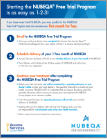
Start your patients with
1 month of free medication†
Patients new to NUBEQA are eligible for up to 1 month of free
treatment. Enroll patients here or contact your sales representative
for a 30-day free sample.
†The NUBEQA Free Trial Program provides 1 month’s supply of NUBEQA at no cost to patients who meet the program eligibility requirements and agree to the terms and conditions. For full terms and conditions and to enroll patients, please call Access Services by Bayer TM at 1-800-288-8374 or visit NUBEQAHCP.com.
ADT=androgen deprivation therapy; ARI=androgen receptor inhibitor; ECOG PS=Eastern Cooperative Oncology Group Performance Status; mCSPC=metastatic castration-sensitive prostate cancer; nmCRPC=non-metastatic castration-resistant prostate cancer; PC=prostate cancer; PSA=prostate-specific antigen; PTSD=post-traumatic stress disorder.
Indications
NUBEQA is an androgen receptor inhibitor indicated for the treatment of adult patients with:
- non-metastatic castration resistant prostate cancer (nmCRPC)
- metastatic castration-sensitive prostate cancer (mCSPC)
- metastatic castration-sensitive prostate cancer (mCSPC) in combination with docetaxel
Important Safety Information
Warnings & Precautions
Ischemic Heart Disease – Ischemic heart disease, including fatal cases, occurred in patients receiving NUBEQA.
In a pooled analysis of ARAMIS and ARANOTE, ischemic heart disease occurred in 3.4% of patients receiving NUBEQA and 2.2% receiving placebo, including Grade 3-4 events in 1.4% and 0.3%, respectively. Ischemic events led to death in 0.4% of patients receiving NUBEQA and 0.4% receiving placebo.
In ARASENS, ischemic heart disease occurred in 3.2% of patients receiving NUBEQA with docetaxel and 2% receiving placebo with docetaxel, including Grade 3-4 events in 1.3% and 1.1%, respectively. Ischemic events led to death in 0.3% of patients receiving NUBEQA with docetaxel and 0% receiving placebo with docetaxel.
Monitor for signs and symptoms of ischemic heart disease. Optimize management of cardiovascular risk factors, such as hypertension, diabetes, or dyslipidemia. Discontinue NUBEQA for Grade 3-4 ischemic heart disease.
Seizure – Seizure occurred in patients receiving NUBEQA.
In a pooled analysis of ARAMIS and ARANOTE, Grade 1-3 seizure occurred in 0.2% of patients receiving NUBEQA. Seizure occurred from 261 to 665 days after initiation of NUBEQA.
In ARASENS, seizure occurred in 0.8% of patients receiving NUBEQA with docetaxel, including two Grade 3 events. Seizure occurred from 38 to 1754 days after initiation of NUBEQA.
It is unknown whether anti-epileptic medications will prevent seizures with NUBEQA. Advise patients of the risk of developing a seizure while receiving NUBEQA and of engaging in any activity where sudden loss of consciousness could cause harm to themselves or others. Consider discontinuation of NUBEQA in patients who develop a seizure during treatment.
Embryo-Fetal Toxicity – The safety and efficacy of NUBEQA have not been established in females. NUBEQA can cause fetal harm and loss of pregnancy. Advise males with female partners of reproductive potential to use effective contraception during treatment with NUBEQA and for 1 week after the last dose.
Adverse Reactions
In ARAMIS, serious adverse reactions occurred in 25% of patients receiving NUBEQA and in 20% of patients receiving placebo. Serious adverse reactions in ≥1% of patients who received NUBEQA included urinary retention, pneumonia, and hematuria. Fatal adverse reactions occurred in 3.9% of patients receiving NUBEQA and 3.2% of patients receiving placebo. Fatal adverse reactions that occurred in ≥2 patients who received NUBEQA included death (0.4%), cardiac failure (0.3%), cardiac arrest (0.2%), general physical health deterioration (0.2%), and pulmonary embolism (0.2%). The most common (>2% with a ≥2% increase compared to placebo) adverse reactions, including laboratory test abnormalities, were increased AST (23%), decreased neutrophil count (20%), fatigue (16%), increased bilirubin (16%), pain in extremity (6%), and rash (4%). Clinically relevant adverse reactions occurring in 2% or more of patients treated with NUBEQA included ischemic heart disease (4%) and heart failure (2.1%).
In ARANOTE, serious adverse reactions occurred in 24% of patients receiving NUBEQA. Serious adverse reactions in ≥1% of patients who received NUBEQA included pneumonia (2%), urinary tract infection (1.8%), musculoskeletal pain (1.6%), hemorrhage (1.6%), arrhythmias (1.3%), and spinal cord compression (1.1%). Fatal adverse reactions occurred in 4.7% of patients receiving NUBEQA and those that occurred in ≥2 patients included sepsis (1.1%), craniocerebral injury (0.4%), and myocardial infarction (0.4%). The most common (≥10% with a ≥2% increase compared to placebo) adverse reaction is urinary tract infection (12%). The most common laboratory test abnormalities (≥15% with a ≥5% increase over placebo) are increased AST (32%), increased ALT (28%), increased bilirubin (17%), and decreased neutrophil count (16%). Clinically relevant adverse reactions in <10% of patients who received NUBEQA included arrhythmia (8.8%), pneumonia (3.6%), and myocardial infarction (0.7%).
In ARASENS, serious adverse reactions occurred in 45% of patients receiving NUBEQA with docetaxel. Serious adverse reactions in ≥2% of patients who received NUBEQA with docetaxel included febrile neutropenia (6%), neutrophil count decreased (2.8%), musculoskeletal pain (2.6%) and pneumonia (2.6%). Fatal adverse reactions occurred in 4% of patients receiving NUBEQA with docetaxel. Fatal adverse reactions in ≥2 patients who received NUBEQA included COVID-19/COVID-19 pneumonia (0.8%), myocardial infarction (0.3%), and sudden death (0.3%). The most common (≥10% with a ≥2% increase over placebo with docetaxel) adverse reactions are constipation (23%), rash (20%), decreased appetite (19%), hemorrhage (18%), increased weight (18%), and hypertension (14%). The most common laboratory test abnormalities (≥30%) are anemia (72%), hyperglycemia (57%), decreased lymphocyte count (52%), decreased neutrophil count (49%), increased AST (40%), increased ALT (37%), and hypocalcemia (31%). Clinically relevant adverse reactions in <10% of patients who received NUBEQA with docetaxel included fractures (8%), ischemic heart disease (3.2%), seizures (0.6%), and drug-induced liver injury (0.3%).
Drug Interactions
Effect of Other Drugs on NUBEQA – Concomitant use of NUBEQA with a combined P-gp and strong or moderate CYP3A4 inducer decreases darolutamide exposure which may decrease NUBEQA activity. Avoid concomitant use of NUBEQA with combined P-gp and strong or moderate CYP3A4 inducers.
Concomitant use of NUBEQA with a combined P-gp and strong CYP3A4 inhibitor increases darolutamide exposure which may increase the risk of NUBEQA adverse reactions. Monitor patients more frequently for NUBEQA adverse reactions and modify NUBEQA dosage as needed.
Effects of NUBEQA on Other Drugs – NUBEQA is an inhibitor of BCRP transporter. Concomitant use of NUBEQA increases the AUC and Cmax of BCRP substrates, which may increase the risk of BCRP substrate-related toxicities. Avoid concomitant use with drugs that are BCRP substrates where possible. If used together, monitor patients more frequently for adverse reactions, and consider dose reduction of the BCRP substrate drug.
NUBEQA is an inhibitor of OATP1B1 and OATP1B3 transporters. Concomitant use of NUBEQA may increase the plasma concentrations of OATP1B1 or OATP1B3 substrates. Monitor patients more frequently for adverse reactions of these drugs and consider dose reduction while patients are taking NUBEQA.
Review the Prescribing Information of drugs that are BCRP, OATP1B1, and OATP1B3 substrates when used concomitantly with NUBEQA.
Please see the full Prescribing Information.
References: 1. NUBEQA (darolutamide) [prescribing information]. Whippany, NJ: Bayer HealthCare Pharmaceuticals, Inc.; June 2025. 2. Saad F, Vjaters E, Shore N, et al. Darolutamide in combination with androgen-deprivation therapy in patients with metastatic hormone-sensitive prostate cancer from the phase III ARANOTE trial. J Clin Oncol. 2024;42(36):4271-4281. 3. Smith MR, Hussain M, Saad F, et al; ARASENS Trial Investigators. Darolutamide and survival in metastatic, hormone-sensitive prostate cancer. N Engl J Med. 2022;386(12):1132-1142. 4. Fizazi K, Shore N, Tammela TL, et al. Darolutamide in nonmetastatic, castration-resistant prostate cancer. N Engl J Med. 2019;380(13):1235-1246. 5. Erleada (apalutamide) [prescribing information]. Horsham, PA: Janssen Products, LP; August 2024. 6. Xtandi (enzalutamide) [prescribing information]. Northbrook, IL: Astellas Pharma US, Inc.; January 2025. 7. Zytiga (abiraterone acetate) [prescribing information]. Horsham, PA: Janssen Biotech, Inc.; November 2024. 8. Lexi-Comp. Interactions - UptoDate Lexidrug. Accessed September 19, 2025. https://online.lexi.com/lco/action. 9. ECOG-ACRIN Cancer Research Group. ECOG Performance Status Scale. Accessed September 19, 2025. https://ecog-acrin.org/resources/ecog-performance-status/. 10. Shore N, Zurth C, Fricke R, et al. Evaluation of clinically relevant drug-drug interactions and population pharmacokinetics of darolutamide in patients with nonmetastatic castration-resistant prostate cancer: results of pre-specified and post hoc analyses of the phase III ARAMIS trial. Target Oncol. 2019;14(5):527-539. 11. Jantoven (warfarin) [prescribing information]. Maple Grove, MN: Upsher-Smith Laboratories, LLC; September 2017. 12. Savaysa (edoxaban) [prescribing information]. Basking Ridge, NJ: Daiichi Sankyo, Inc.; October 2023. 13. Argatroban [prescribing information]. Lake Forest, IL: Hospira Inc.; September 2019. 14. Pradaxa (dabigatran etexilate) [prescribing information]. Ridgefield, CT: Boehringer Ingelheim Pharmaceuticals, Inc.; November 2023. 15. Fragmin (dalteparin sodium) [prescribing information]. New York, New York: Pfizer Labs; October 2024. 16. Lovenox (enoxaparin sodium) [prescribing information]. Bridgewater, NJ: Sanofi-Aventis U.S. LLC; April 2022. 17. Arixtra (fondaparinux sodium injection) [prescribing information]. Morgantown, WV: Mylan Institutional LLC; August 2020. 18. Heparin sodium injection [prescribing information]. Eatontown, NJ: Hikma Pharmaceuticals USA Inc.; April 2024.