
COMPREHENSIVE RESOURCES FOR YOUR PATIENTS AND THEIR CAREGIVERS

Jump to Section
Patient resources
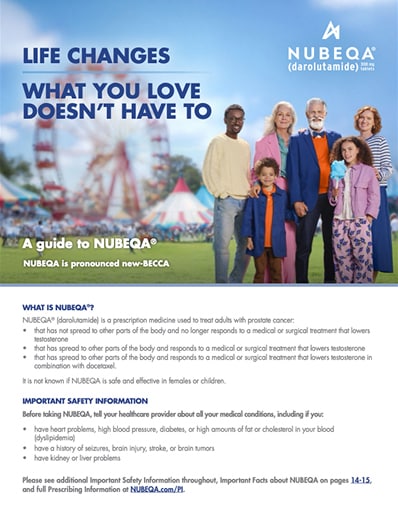
Patient Brochure
Available in English, Spanish & Chinese
A patient-friendly explanation of what NUBEQA is, how it works, its efficacy, safety, and information about access and support
Patient Access Guide
Information for physicians and patients on the many NUBEQA access and support programs available
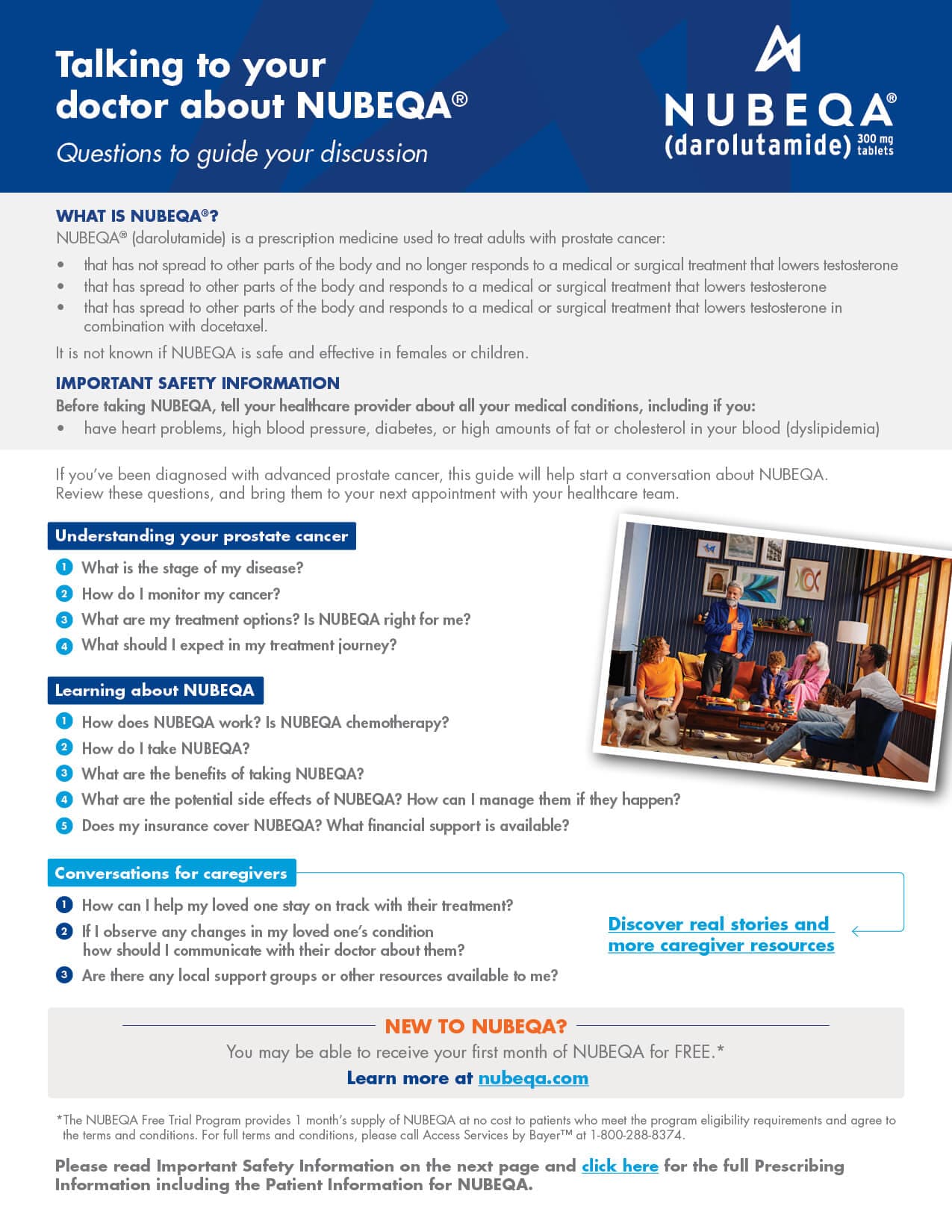
HCP Discussion Guide
Questions for patients to guide their discussions with HCPs about NUBEQA
Caregiver resources
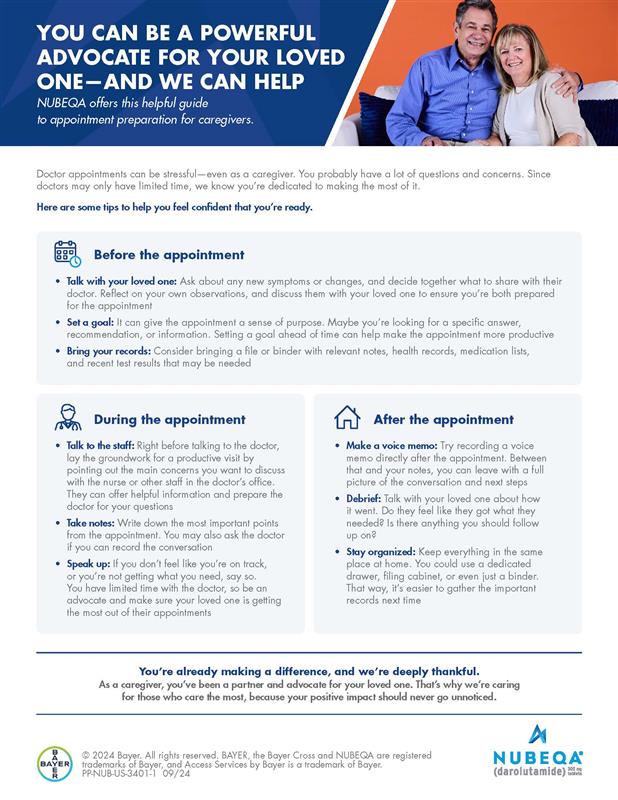

Encourage your patients and their caregivers to find additional resources at NUBEQA.com, as part of the comprehensive support offerings from Bayer, including support group information, tips for preparing for appointments, and patient testimonials.

“The conversation around whether or not NUBEQA is the right treatment for that particular patient needs to happen. It’s a shared decision, understanding the benefits of being on NUBEQA, and also the potential side effects.” —Pedro Barata, MD, oncologist

We appreciate the meaningful conversations you have with patients and caregivers alike.
HCP=healthcare professional.
Indications
NUBEQA is an androgen receptor inhibitor indicated for the treatment of adult patients with:
- non-metastatic castration resistant prostate cancer (nmCRPC)
- metastatic castration-sensitive prostate cancer (mCSPC)
- metastatic castration-sensitive prostate cancer (mCSPC) in combination with docetaxel
Important Safety Information
Warnings & Precautions
Ischemic Heart Disease – Ischemic heart disease, including fatal cases, occurred in patients receiving NUBEQA.
In a pooled analysis of ARAMIS and ARANOTE, ischemic heart disease occurred in 3.4% of patients receiving NUBEQA and 2.2% receiving placebo, including Grade 3-4 events in 1.4% and 0.3%, respectively. Ischemic events led to death in 0.4% of patients receiving NUBEQA and 0.4% receiving placebo.
In ARASENS, ischemic heart disease occurred in 3.2% of patients receiving NUBEQA with docetaxel and 2% receiving placebo with docetaxel, including Grade 3-4 events in 1.3% and 1.1%, respectively. Ischemic events led to death in 0.3% of patients receiving NUBEQA with docetaxel and 0% receiving placebo with docetaxel.
Monitor for signs and symptoms of ischemic heart disease. Optimize management of cardiovascular risk factors, such as hypertension, diabetes, or dyslipidemia. Discontinue NUBEQA for Grade 3-4 ischemic heart disease.
Seizure – Seizure occurred in patients receiving NUBEQA.
In a pooled analysis of ARAMIS and ARANOTE, Grade 1-3 seizure occurred in 0.2% of patients receiving NUBEQA. Seizure occurred from 261 to 665 days after initiation of NUBEQA.
In ARASENS, seizure occurred in 0.8% of patients receiving NUBEQA with docetaxel, including two Grade 3 events. Seizure occurred from 38 to 1754 days after initiation of NUBEQA.
It is unknown whether anti-epileptic medications will prevent seizures with NUBEQA. Advise patients of the risk of developing a seizure while receiving NUBEQA and of engaging in any activity where sudden loss of consciousness could cause harm to themselves or others. Consider discontinuation of NUBEQA in patients who develop a seizure during treatment.
Embryo-Fetal Toxicity – The safety and efficacy of NUBEQA have not been established in females. NUBEQA can cause fetal harm and loss of pregnancy. Advise males with female partners of reproductive potential to use effective contraception during treatment with NUBEQA and for 1 week after the last dose.
Adverse Reactions
In ARAMIS, serious adverse reactions occurred in 25% of patients receiving NUBEQA and in 20% of patients receiving placebo. Serious adverse reactions in ≥1% of patients who received NUBEQA included urinary retention, pneumonia, and hematuria. Fatal adverse reactions occurred in 3.9% of patients receiving NUBEQA and 3.2% of patients receiving placebo. Fatal adverse reactions that occurred in ≥2 patients who received NUBEQA included death (0.4%), cardiac failure (0.3%), cardiac arrest (0.2%), general physical health deterioration (0.2%), and pulmonary embolism (0.2%). The most common (>2% with a ≥2% increase compared to placebo) adverse reactions, including laboratory test abnormalities, were increased AST (23%), decreased neutrophil count (20%), fatigue (16%), increased bilirubin (16%), pain in extremity (6%), and rash (4%). Clinically relevant adverse reactions occurring in 2% or more of patients treated with NUBEQA included ischemic heart disease (4%) and heart failure (2.1%).
In ARANOTE, serious adverse reactions occurred in 24% of patients receiving NUBEQA. Serious adverse reactions in ≥1% of patients who received NUBEQA included pneumonia (2%), urinary tract infection (1.8%), musculoskeletal pain (1.6%), hemorrhage (1.6%), arrhythmias (1.3%), and spinal cord compression (1.1%). Fatal adverse reactions occurred in 4.7% of patients receiving NUBEQA and those that occurred in ≥2 patients included sepsis (1.1%), craniocerebral injury (0.4%), and myocardial infarction (0.4%). The most common (≥10% with a ≥2% increase compared to placebo) adverse reaction is urinary tract infection (12%). The most common laboratory test abnormalities (≥15% with a ≥5% increase over placebo) are increased AST (32%), increased ALT (28%), increased bilirubin (17%), and decreased neutrophil count (16%). Clinically relevant adverse reactions in <10% of patients who received NUBEQA included arrhythmia (8.8%), pneumonia (3.6%), and myocardial infarction (0.7%).
In ARASENS, serious adverse reactions occurred in 45% of patients receiving NUBEQA with docetaxel. Serious adverse reactions in ≥2% of patients who received NUBEQA with docetaxel included febrile neutropenia (6%), neutrophil count decreased (2.8%), musculoskeletal pain (2.6%) and pneumonia (2.6%). Fatal adverse reactions occurred in 4% of patients receiving NUBEQA with docetaxel. Fatal adverse reactions in ≥2 patients who received NUBEQA included COVID-19/COVID-19 pneumonia (0.8%), myocardial infarction (0.3%), and sudden death (0.3%). The most common (≥10% with a ≥2% increase over placebo with docetaxel) adverse reactions are constipation (23%), rash (20%), decreased appetite (19%), hemorrhage (18%), increased weight (18%), and hypertension (14%). The most common laboratory test abnormalities (≥30%) are anemia (72%), hyperglycemia (57%), decreased lymphocyte count (52%), decreased neutrophil count (49%), increased AST (40%), increased ALT (37%), and hypocalcemia (31%). Clinically relevant adverse reactions in <10% of patients who received NUBEQA with docetaxel included fractures (8%), ischemic heart disease (3.2%), seizures (0.6%), and drug-induced liver injury (0.3%).
Drug Interactions
Effect of Other Drugs on NUBEQA – Concomitant use of NUBEQA with a combined P-gp and strong or moderate CYP3A4 inducer decreases darolutamide exposure which may decrease NUBEQA activity. Avoid concomitant use of NUBEQA with combined P-gp and strong or moderate CYP3A4 inducers.
Concomitant use of NUBEQA with a combined P-gp and strong CYP3A4 inhibitor increases darolutamide exposure which may increase the risk of NUBEQA adverse reactions. Monitor patients more frequently for NUBEQA adverse reactions and modify NUBEQA dosage as needed.
Effects of NUBEQA on Other Drugs – NUBEQA is an inhibitor of BCRP transporter. Concomitant use of NUBEQA increases the AUC and Cmax of BCRP substrates, which may increase the risk of BCRP substrate-related toxicities. Avoid concomitant use with drugs that are BCRP substrates where possible. If used together, monitor patients more frequently for adverse reactions, and consider dose reduction of the BCRP substrate drug.
NUBEQA is an inhibitor of OATP1B1 and OATP1B3 transporters. Concomitant use of NUBEQA may increase the plasma concentrations of OATP1B1 or OATP1B3 substrates. Monitor patients more frequently for adverse reactions of these drugs and consider dose reduction while patients are taking NUBEQA.
Review the Prescribing Information of drugs that are BCRP, OATP1B1, and OATP1B3 substrates when used concomitantly with NUBEQA.
Please see the full Prescribing Information.